Saturday, January 25, 2014

Four Beauties

Tallulah Bankhead

"Faithless," 1932.
Tallulah Bankhead had a much bigger career on stage than on film.  I had only really known her from Hitchcock's "Lifeboat" (1944).  Hollywood tried to make her a star in the early thirties, but they had a difficult time casting her.  I think she's actually well cast in "Faithless" as a society girl who blows her fortune, then mooches off her friends until they tire of her.  She ends up a kept woman of a crass, married businessman.  When she runs into an old flame, noble but now penniless and unemployed, she takes a chance and marries him.  They struggle to find work, living in cheap hotels, going without meals.  Tallulah, desperate, thinks about turning tricks; a kind-hearted cop gets her a job. 

I was impressed with the way she goes from being a shallow, spoiled socialite, to hardened, bitter mistress.   And the later scenes with her husband, Robert Montgomery, are quite touching as they struggle to find work and they move from one cheap boarding house to another.  They seem really desperate as they get work and lose it, and can't afford food or doctors.

Joan Crawford
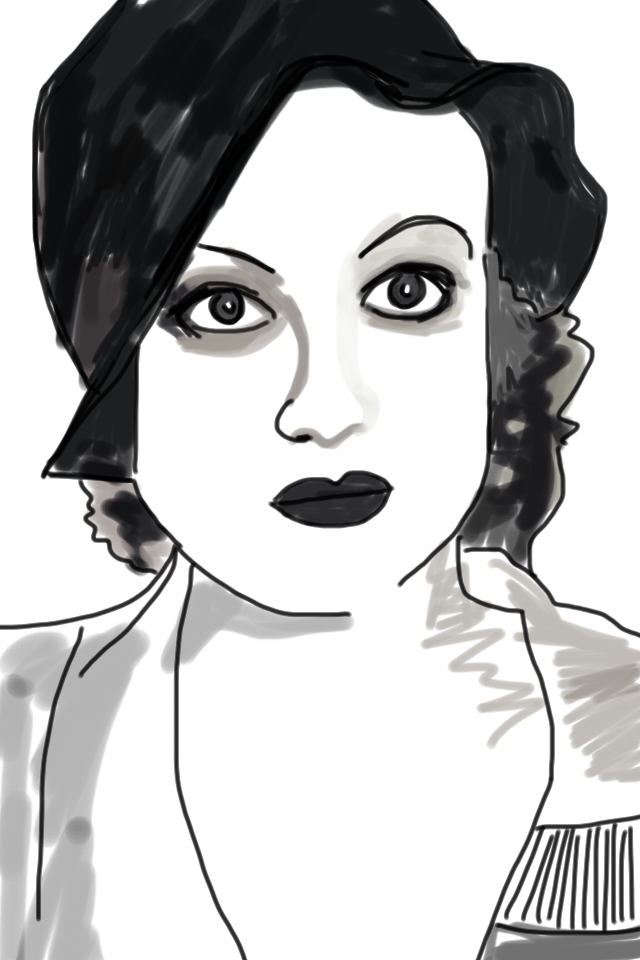
"Grand Hotel," 1932
Joan Crawford had already appeared in over thirty films when she appeared in the ensemble film "Grand Hotel" in 1932.  She's great in a cast that includes two Barrymores, Greta Garbo, and Wally Beery.  I like the way she plays businessman Beery into getting him to pay through the nose for her secretarial services; her playful banter with John Barrymore is pretty funny; and her final scenes with the old man Lionel Barrymore are very touching.

Rita Hayworth 


"You'll Never Get Rich," 1941.
I couldn't get into this film.  Not enough dancing or singing, considering it stars Fred Astaire along with Rita.  Showgirl Rita is being chased by an impresario; when his wife finds out Fred has to step in and pretend to be one the guy who's really interested in Rita.  But what man wouldn't be?  The characters go through great lengths to avoid connecting with each other; the contrived plot gets in the way of the people actually pursuing realistic goals.

But there are some nice comedic scenes, especially featuring Astaire and Hayworth.

Veronica Lake


"Sullivan's Travels" 1941.
Here's Veronica Lake in one of my favorite films, from one of my favorite Depression era directors, Preston Sturges.  Veronica Lake had such a promising start to her career, it saddens me she didn't make more noteworthy films.  She's also wonderful in "I Married a Witch," "This Gun for Hire," "The Blue Dahlia" and "The Glass Key."  Looking at her bio there are a few films of hers I need to see, including "Ramrod" (also with Joel McCrea).  But too many of her films were of lesser quality and I don't think they made the most of her talents. 

(all sketches by J. Betke)

Tuesday, January 7, 2014

Backyard Sledding!

Augie describes the hill he made in his backyard for sledding!


"Good hill!"


Thursday, December 12, 2013

A Winter Walk through the Forest Preserve

Augie finds animals looking for food in the cold.  He finds a deer, a squirrel, and a woodpecker!

Wednesday, December 11, 2013

Three Stars from the Thirties

Claudette Colbert, "Cleopatra," 1934.
Claudette Colbert actually made a great Cleopatra in the 1934 film, of the same name, directed by Cecil B. DeMille.  It's a tough role.  The Queen of the Nile has to be seductive and devious, thinking she is in control of her and Egypt's fate, while at the same time she's very naive about Roman politics.  She leads both Julius Caesar and Marc Antony to their doom, in a way that seems utterly convincing.  Warren William is familiar to many movie buffs as a smooth talking, somewhat duplicitous leading man in many early talkies; he seems too smart for his own good in this film as Caesar, thinking he controls Cleopatra when she is really controlling him.  Henry Wilcoxon as Antony is less nuanced; he's just a drinker, fighter, and lover who seems honestly baffled when first his Roman generals desert him, and the Cleopatra flees to save her own skin at his expense.
Randolph Scott, "Roberta," 1935.
Randolph Scott was so well known for his many roles in Westerns that seeing him in romantic comedies is sometimes a surprise.  I forget he was great in films like "My Favorite Wife."  In the 1935 film "Roberta" he stars alongside Fred Astaire and Ginger Rogers.  It's a silly film with a complicated plot - in France tagging along with Astaire's band, American football player Scott finds out his aunt, who owns a wildly successful haute couture, dies, leaving him the shop.  He ends up in a romantic triangle between his snooty girl visiting from back home and the shop's manager, played by Irene Dunne.  It's the main plot of the film, with Astaire and Rogers (who plays a counterfeit Russian duchess - see, the plot is complicated) relegated to the singing and dancing interludes.  I missed the ending - but I'm guessing Scott ended up with Dunne and either they both returned to America or he stayed to help run the shop!

Priscilla Lane, "The Roaring Twenties," 1939.
Priscilla Lane was one of the five Lane Sisters, four of whom were singers and actresses, and three of whom made the successful jump to the Silver Screen in the 1930s.  Priscilla had the biggest career, appearing in over 20 films, including the classics "Arsenic and Old Lace" and "Saboteur."  In "The Roaring Twenties" she's the young ingenue Great War-veteran-turned-bootlegger Jimmy Cagney falls hard for; but she instead marries one of his war buddies, a young lawyer on his way to become a District Attorney.  Conflict ensues.  As in all of her roles she's sweet and likeable, the girl the hero makes sacrifices for and sometimes loses to a better man. 


Saturday, November 23, 2013

Four Villains, One Hero


Gail Patrick, "My Man Godfery," 1936.
 I love Gail Patrick.  I think she's great at playing believable "other women" who are really just misunderstood.  In "Godfrey" she's the older sister who thinks that Godfrey - a rich man willing to play a butler - has a secret.  Turns out she was right, but not in the way she thought.  She's smart but too cunning for her own good.  In Godfrey she learns a lesson about misjudging people, something a lot of people in the 1930s needed to also learn.
Sterling Hayden, ""Dr. Strangelove; or How I Learned to Stop Worrying and Love the Bomb," 1964.
The perfect portrayal of the paranoid conspiracy theorist.   "Purity of Essence."  What frightens me about "Strangelove" is how slow the responsible people are to recognize the insanity around them, and how much power wackos like Hayden's Gen. Ripper have over the rest of us.
 
Burt Lancaster, "Sweet Smell of Success," 1957.
Burt Lancaster, a gossip columnist along the lines of Walter Winchell, wants to break up his younger sister's romance to a musician; he uses Tony Curtis, an amoral publicist, to pull the strings.  Lancaster spends much of this film lying through his teeth and then being appalled when people don't believe him.  He's a snake.

Ann Blyth, "Mildred Pierce," 1945.
In "Mildred Pierce," Ann Blyth portrays the meanest, most ungrateful child in the history of cinema.  Her mother rises from poverty to create something of a restaurant empire, all so her daughter can lead a better life.  But Ann, as Veda, is dismissive of her mother's struggles, as if wealth just appears, and is even disdainful of her mother's attempts to protect her.  When she gets slapped late in the film, we cheer, because she deserves it.

Humphrey Bogart, "The Maltese Falcon," 1941.
Bogart, as Sam Spade, is the hero of "The Maltese Falcon," but he's not a really great guy.  He never really grieves for his dead partner; he's sympathetic to Mary Astor, but quickly gives her up for the Archer's murder, telling her sarcastically that he'll "wait for her."  He's cynical and bitter and hard-boiled, the way our detective heroes ought to be.

Monday, November 11, 2013

Powell and Loy in "Love Crazy"

      Myrna Loy and William Powell starred in six "Thin Man" films as Nora and Nick Charles, but they also made a few other films together, including this funny screwball comedy.  In 1941's "Love Crazy" they are a married couple celebrating their fourth wedding anniversary when a series of miscommunications results in them splitting up; Powell then pretends to be crazy to keep Loy from being able to divorce him, and to give him time to win her back.  It's a silly movie that benefits from a great supporting cast. 


Myrna Loy, "Love Crazy," 1941.
      Gail Patrick plays an old flame of Powell who just happens to also live in the same apartment building; they have a funny slapstick scene where they get stuck in an elevator.  Patrick played a tough-as-nails "other woman" in a number of great films, including "My Man Godfrey" and "My Favorite Wife." 

      The other great character actor here is Jack Carson, as a muscle-bound neighbor Loy attempts to use for "revenge" against Powell.  Carson made a career playing the often more extroverted, funnier, and interesting sidekicks in many great films, sometimes playing a good-natured cad.  He's especially great in "Mildred Pierce" and Hitchcock's "Mr. and Mrs. Smith."


William Powell, "Love Crazy," 1941.
      A final note about "Love Crazy." At the end of the film William Powell has to pretend to be his own sister after escaping from an insane asylum (this is a screwball comedy, after all).  To do the scene he had to shave off his trademark mustache, and this is the only time I remember seeing hm on screen completely clean shaven.  He looks strange!

Monday, November 4, 2013

"The Goddess"

It's nice to be surprised by a film or performance that has somehow flown under my radar.  This past weekend I watched "The Goddess," a silent film from China from 1934.  I first heard of the film while watching "The Story of Film: An Odyssey," by critic Mark Cousins, on Turner Classic Movies.  That documentary series is one man's interpretation of the history of film.  Instead of looking at film as an American phenomenon, he's looking at how cinema spread across the world and sort of cross-pollinated different film cultures.   He spent some time talking about "The Goddess" and its star, Lingyu Ruan, in a recent episode.
Lingyu Ruan, "The Goddess," 1934.
In the film she plays a prostitute in modern day Shanghai, trying to support her son and give him a better life.  She ends up getting involved with a brutal pimp, but she tries to secretly save extra money for a possible escape.  She uses the rest of the money she earns to send her son to a good school; when the other parents discover her secret, they try to force her son out.  The Principal tries to intervene on her behalf, but is forced to resign.  When the mother decides to leave town with her son, and try to start a new life, she finds her secret money has been stolen by the pimp.  She confronts him, he ignores her pleas, and she strikes him over the head with a bottle, killing him. 

Sent to jail, the now ex-Principal finds her and tells her he will take care of her son and get him a proper education, leaving her with some comfort.

It's a brutal film.  The love she shows for her son, and the compassion of the school Principal, is almost crushed by her circumstances.  Today many prostitutes are seen for what they really are, victims and not criminals, and how she defends herself against the pimp would be seen as self-defense.  But in this film, in 1934, she's treated like a degenerate criminal. 

She even considers herself degenerate, which is one of the most moving parts of this film.  Lingyu Ruan portrays a woman who thinks so little of herself, but in reality she is the strongest and most compassionate person in the story.  And it's almost a relief when the Principal recognizes her strength.

Sadly this actress committed suicide a year after this film was made.  She was subjected to much of the same scorn from the people of China, because she was a film actress, as was her character of a prostitute.  I'll be looking for a deeper biography of her and I'd like to see more of her films.